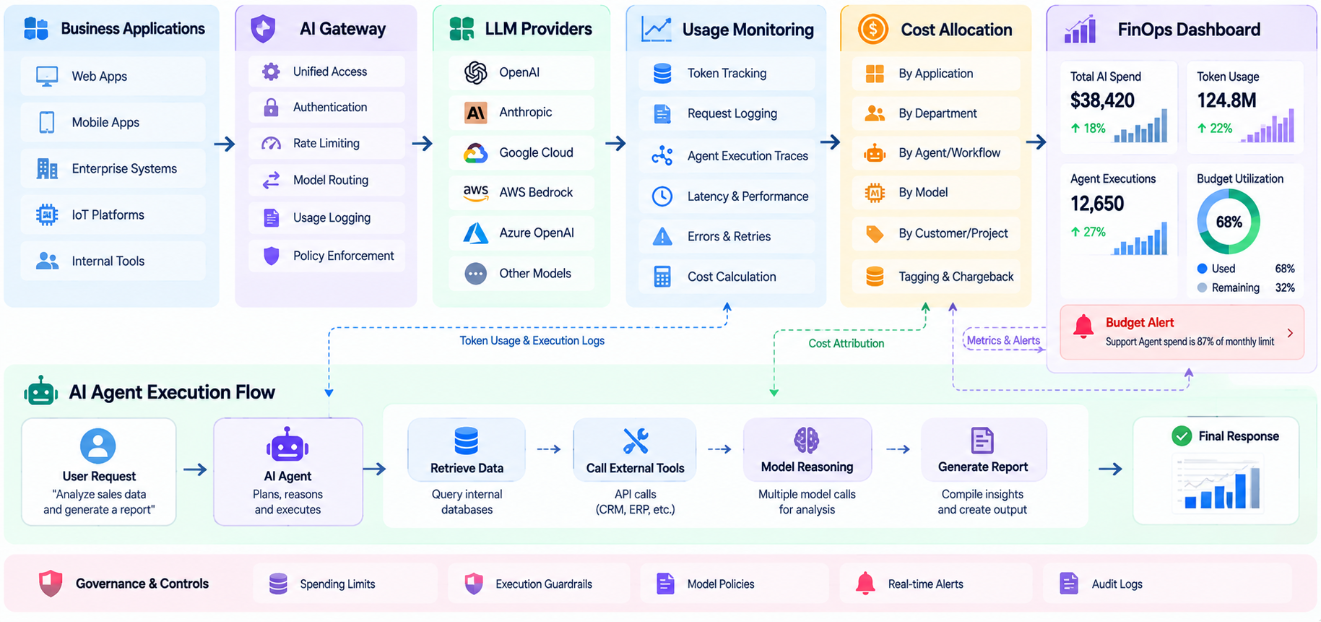

AI FinOps: Why CFOs Must Track Token and AI Agent Costs

Generative AI is moving from experimentation into everyday business operations. Companies are deploying AI assistants, integrating large language models into applications, and introducing autonomous agents to automate business processes.
But a new financial challenge is emerging.
Unlike traditional software, where infrastructure expenses are relatively predictable, AI costs can change with every request, conversation, and automated action. A single AI agent may execute several model calls, retrieve documents, interact with external services, and repeat tasks before completing one user request.
For CFOs and technology leaders, the challenge is no longer simply how much AI infrastructure costs.
It is understanding where AI spending occurs, what drives it, and whether the investment produces measurable business value.
This is where AI FinOps becomes important.
What Is AI FinOps?
AI FinOps is the practice of managing, monitoring, and optimizing the financial costs associated with artificial intelligence systems.
It extends traditional Financial Operations, commonly called FinOps, into AI workloads such as large language models, generative AI applications, machine learning infrastructure, and autonomous AI agents.
Traditional FinOps focuses primarily on cloud infrastructure expenses, including computing, storage, networking, and resource utilization.
AI FinOps introduces additional financial dimensions.
Organizations must understand how much they spend on:
- Input and output tokens consumed by language models.
- API calls to external AI model providers.
- AI inference and model hosting infrastructure.
- Autonomous AI agent execution.
- Vector databases and retrieval systems.
- Model training and fine-tuning.
- Data processing and storage.
- Monitoring, evaluation, and security controls.
The objective is not simply to reduce AI expenses.
It is to ensure that AI spending remains visible, predictable, and aligned with business outcomes.
Why Traditional Cloud Cost Management Is Not Enough
Consider a company operating a conventional customer support application.
Its cloud infrastructure may include application servers, databases, storage, and networking services. While traffic fluctuates, infrastructure consumption can often be estimated using historical demand.
Now imagine that the company introduces an AI-powered customer support assistant.
Every customer interaction may involve several additional operations.
The assistant receives a question, retrieves relevant documents, sends context to a language model, generates an answer, and potentially calls another service.
Each operation may contribute to the overall cost.
Two customer conversations that appear similar can consume very different amounts of computing resources.
A simple password reset question may require one model request.
A complex billing dispute may require document retrieval, multiple model calls, and several tool interactions.
The application may process the same number of customer requests while generating significantly different AI expenses.
This makes traditional infrastructure monitoring insufficient for understanding the complete financial picture.
The key difference is that AI costs depend not only on application usage but also on how the AI system behaves during each interaction.
Why CFOs Need Visibility Into AI Token Spending
Large language models process text using units called tokens.
A token may represent a word, part of a word, punctuation, or another segment of text.
Many commercial language model APIs charge based on the number of input and output tokens processed.
Input tokens represent information sent to the model.
Output tokens represent information generated by the model.
Some providers also distinguish cached input tokens, reasoning-related usage, and other billable operations.
This creates a variable cost structure that organizations must monitor carefully.
How AI Token Costs Accumulate
Consider a hypothetical enterprise application that processes 100,000 AI requests every month.
Assume each request consumes:
- 2,000 input tokens.
- 500 output tokens.
- $2 per million input tokens.
- $8 per million output tokens.
These rates are illustrative and do not represent a specific provider's current pricing.
The monthly input token consumption would be:
100,000 × 2,000 = 200 million input tokens.
At $2 per million tokens, the input cost would be $400.
The monthly output token consumption would be:
100,000 × 500 = 50 million output tokens.
At $8 per million tokens, the output cost would also be $400.
The total estimated model usage cost would be $800 per month.
Now imagine that application usage increases tenfold.
Without changes to token consumption or pricing, the monthly model usage cost would increase to approximately $8,000.
This calculation excludes additional expenses such as document retrieval, hosting, storage, monitoring, and external tool usage.
The example illustrates an important point.
AI costs can scale directly with usage, but they can also increase because individual requests become more complex.
Why Token Visibility Matters
Monitoring the total monthly AI bill is useful, but it does not explain what drives spending.
Organizations need visibility into several operational dimensions.
Cost by application: Which AI-powered products consume the largest share of the budget?
Cost by department: How much does the sales team spend compared with customer support or engineering?
Cost by model: Are expensive models being used for tasks that smaller models could handle?
Cost by workflow: Which business processes generate the highest AI expenses?
Cost per outcome: How much does it cost to resolve a support ticket, process an invoice, or complete a document review?
These measurements help finance and engineering teams connect technical consumption with business value.
Without this visibility, AI spending becomes another growing technology expense with limited accountability.
AI Agents Introduce a New Cost Management Challenge
AI agents are different from traditional AI chatbots.
A chatbot typically responds to a user request.
An AI agent may plan a task, use external tools, retrieve information, make intermediate decisions, and execute multiple steps before producing a result.
This introduces additional complexity into AI cost management.
The Hidden Cost of Agent Execution
Imagine an AI agent responsible for preparing a weekly sales performance report.
The user asks:
"Analyze last week's sales performance and identify the main reasons for changes in revenue."
The agent may perform the following operations:
- Retrieve sales information from a database.
- Fetch customer activity from a CRM system.
- Analyze changes across regions.
- Generate several intermediate summaries.
- Compare results with previous reporting periods.
- Prepare recommendations.
- Generate the final report.
Each step may require one or more language model calls.
Some steps may also trigger external API charges, database processing, or additional infrastructure usage.
A workflow that appears to be a single user request could involve dozens of internal operations.
If the agent encounters errors or repeatedly attempts unsuccessful actions, costs may increase further.
This is why AI agent cost management requires visibility into the entire execution process, not just the final response.
Why Autonomous Agents Can Create Unexpected Expenses
Autonomous systems introduce several cost risks.
Repeated reasoning: An agent may perform unnecessary intermediate analysis before completing a task.
Excessive tool calls: Poorly designed workflows may repeatedly access databases or external APIs.
Large context windows: Agents may continuously add conversation history and retrieved information to model requests.
Retry loops: Failed operations may trigger repeated model calls without effective limits.
Uncontrolled parallel execution: Multiple agents may perform overlapping work simultaneously.
Expensive model selection: Organizations may use high-cost models for routine operations that do not require advanced reasoning.
These behaviors can increase operational expenses without improving the final business outcome.
For finance leaders, the important question is not simply how many AI agents are running.
It is how much each agent costs to complete a useful task.
How AI FinOps Works: From Token Usage to Financial Accountability
An effective AI FinOps framework connects technical telemetry with financial reporting.
The objective is to create a clear relationship between AI activity, resource consumption, cost, and business outcomes.
1. Capture AI Usage Data
The first step is collecting detailed information about AI model usage.
Applications should record relevant information for each model request, including:
- Model identifier and version.
- Input token consumption.
- Output token consumption.
- Cached token usage, where applicable.
- Request duration.
- Application or service identifier.
- Department or business unit.
- Workflow or agent identifier.
- Request status.
- Provider-reported usage and applicable pricing.
This information provides the foundation for cost attribution.
Organizations should avoid storing sensitive prompts or personal information unnecessarily. In many cases, token counts, request identifiers, and operational metadata are sufficient for financial monitoring.
2. Track Complete AI Agent Workflows
Token usage alone does not reveal the complete cost of an autonomous workflow.
AI FinOps systems should connect individual model calls to the agent execution that generated them.
For example, a single report-generation workflow might involve 12 model calls, four database queries, and two external API requests.
Tracking these activities under one workflow identifier allows organizations to calculate the total execution cost.
It also helps engineering teams identify unnecessary operations.
3. Allocate Costs to Business Functions
AI spending becomes more useful when organizations can assign expenses to specific teams, products, customers, or workflows.
A centralized AI platform might support marketing, finance, engineering, and customer support.
Without cost allocation, all expenses may appear under one technology budget.
With AI FinOps, the organization can identify which departments consume resources and whether those resources deliver measurable benefits.
This approach supports internal chargeback, showback reporting, and more accurate budgeting.
4. Establish Budgets and Spending Controls
Organizations should define financial limits for AI workloads.
These controls may include:
- Monthly spending budgets.
- Maximum cost per workflow.
- Token limits for individual requests.
- Agent execution time limits.
- Maximum retry attempts.
- Alerts when spending exceeds defined thresholds.
- Approval requirements for expensive operations.
Some controls can be enforced directly within applications. Others require monitoring and governance processes.
Budget alerts alone do not prevent overspending. Applications also need mechanisms to stop, defer, or downgrade expensive operations when appropriate.
5. Measure Business Outcomes
Cost reduction is only one part of AI FinOps.
Organizations also need to measure the value generated by AI applications.
For example, a customer support assistant might reduce the average time required to resolve routine issues.
A document-processing agent might reduce manual review effort.
An AI development assistant might help engineers complete repetitive coding tasks more efficiently.
The relevant financial measurement is the cost of achieving the desired outcome.
An AI workflow costing $0.20 per successful task may be more valuable than one costing $0.05 if the cheaper workflow frequently fails and requires human intervention.
The objective is to optimize cost per successful business outcome rather than cost per token alone.
If your organization is deploying generative AI or autonomous agents, understanding these cost drivers early can help prevent expensive architectural changes later. Infolitz helps businesses design AI applications with usage monitoring, operational controls, and cost visibility built into the architecture.
AI FinOps Tools and Technology Stack
AI FinOps typically involves several technologies working together.
There is no single tool that automatically provides complete visibility across every AI platform, infrastructure provider, and business workflow.
Organizations often combine existing cloud financial management capabilities with AI-specific monitoring and application-level instrumentation.
Cloud Cost Management Platforms
Cloud providers offer tools for tracking infrastructure spending.
Examples include:
Helps organizations analyze cloud service expenses, identify spending trends, and understand resource consumption.
Provides cost analysis, budgeting, and financial visibility for Azure environments.
Supports cloud cost reporting, budgeting, and billing analysis.
These tools are useful for infrastructure-level financial management.
However, their native billing data may not explain the complete cost of individual AI conversations or autonomous agent workflows.
AI Observability Platforms
AI observability tools help engineering teams understand application behavior.
They may provide information about:
- Model request volume.
- Token consumption.
- Request latency.
- Agent execution traces.
- Errors and retries.
- Model performance.
- Workflow behavior.
Examples include Langfuse, LangSmith, and Arize Phoenix.
Capabilities differ across platforms, and organizations should evaluate deployment requirements, data retention, pricing, and integration support.
AI Gateway and Model Routing
An AI gateway provides a centralized access layer between applications and language model providers.
Depending on the implementation, it can support:
- Centralized model access.
- Usage logging.
- Authentication.
- Rate limiting.
- Model routing.
- Cost tracking.
- Policy enforcement.
An AI gateway can simplify financial monitoring when multiple applications use different model providers.
However, gateway-level information may still need to be combined with application telemetry to calculate the full cost of an agent workflow.
Business Intelligence and Financial Reporting
Organizations can connect AI usage information to business intelligence platforms.
Dashboards can display:
- Monthly AI expenditure.
- Spending by application.
- Token consumption trends.
- Cost per customer.
- Cost per successful workflow.
- Budget utilization.
- Forecasted expenses.
Finance teams can use these reports for budgeting and financial planning, while engineering teams use the same information to identify optimization opportunities.
AI FinOps Best Practices: How to Control AI Spending
Organizations do not need to wait until AI expenses become significant before implementing financial controls.
Cost visibility is easier to introduce during application development than after several disconnected AI systems are already operating.
Start With a Cost Baseline
Measure existing AI consumption before introducing optimization strategies.
Identify the applications, models, and workflows responsible for spending.
Track costs over a representative period and account for variations in business activity.
Without a baseline, it becomes difficult to determine whether an optimization has actually improved financial performance.
Use the Right Model for Each Task
Not every AI request requires the most capable or expensive language model.
Simple classification, extraction, and formatting tasks may work well with smaller models.
Complex reasoning or specialized analysis may require more advanced models.
Model selection should consider accuracy, latency, reliability, and cost.
Choosing the cheapest model without evaluating output quality can create additional expenses through errors and rework.
Reduce Unnecessary Token Consumption
Large prompts increase processing costs.
Applications should avoid sending unnecessary conversation history, duplicate instructions, or irrelevant retrieved documents.
Practical optimization techniques include:
- Shortening repetitive system instructions.
- Retrieving only relevant document sections.
- Summarizing older conversation history when appropriate.
- Reusing cached context where supported.
- Limiting unnecessarily long responses.
- Avoiding duplicate model requests.
These techniques should be tested to ensure they do not reduce answer quality.
Introduce Agent Execution Limits
Autonomous agents should operate within clearly defined boundaries.
Organizations can establish limits for:
- Maximum execution steps.
- Maximum tool calls.
- Maximum retries.
- Maximum workflow duration.
- Maximum spending per execution.
When an agent exceeds a threshold, the system can stop execution, request human approval, or switch to a lower-cost workflow.
These controls improve financial predictability and operational safety.
Monitor Cost Per Successful Task
Traditional usage metrics focus on requests, tokens, and API calls.
AI FinOps should also measure the cost of successful outcomes.
For example, consider two document-processing systems.
System A costs $0.10 per document but successfully processes only 70% of documents without manual intervention.
System B costs $0.15 per document and successfully processes 95%.
If both systems process 10,000 documents, their model-related processing expenses would be $1,000 and $1,500, respectively.
However, System A would leave 3,000 documents requiring additional handling, compared with 500 for System B.
Once manual review and reprocessing expenses are included, System B may deliver better overall economics.
The example illustrates why organizations should evaluate total workflow cost rather than model usage cost in isolation.
Common AI FinOps Mistakes
Several practices can undermine AI financial management.
Monitoring only provider invoices: Monthly invoices show total spending but may not explain which workflows generated the costs.
Ignoring agent retries: Failed or repeated operations can consume significant resources.
Optimizing tokens without evaluating quality: Aggressive cost reduction can increase business errors.
Using one model for every task: Different workloads require different levels of model capability.
Failing to assign cost ownership: Shared AI budgets can make accountability difficult.
Ignoring security and governance: Uncontrolled AI access can introduce financial, operational, and data protection risks.
A practical AI FinOps program addresses these issues through both technical controls and organizational processes.
Performance, Cost, and Security Considerations
AI FinOps is closely connected to application performance and security.
Reducing expenses should not create unacceptable delays, unreliable outputs, or additional business risks.
Cost and Latency Trade-Offs
Lower-cost models may have different response times, capabilities, and accuracy characteristics.
Organizations should evaluate model choices against application requirements.
A customer-facing assistant may need consistently fast responses.
A background document analysis process may tolerate longer execution times if the cost savings are meaningful.
Performance requirements should guide optimization decisions.
Data Privacy and Financial Monitoring
AI usage monitoring should not become an unnecessary repository of sensitive business information.
Organizations should consider:
- Limiting stored prompt and response content.
- Removing or masking sensitive information.
- Applying role-based access controls.
- Encrypting monitoring data.
- Defining retention periods.
- Maintaining audit logs for financial changes.
Financial teams usually need usage and cost information rather than complete access to customer conversations.
Preventing Uncontrolled AI Consumption
AI systems can experience unexpected demand because of software defects, retry loops, automated abuse, or poorly configured agents.
Organizations should combine financial monitoring with operational safeguards.
These may include rate limits, execution budgets, authentication, anomaly detection, and automated alerts.
For critical workflows, organizations should also define how applications behave when spending limits are reached.
A system that stops unexpectedly may create greater business losses than the AI expenses it was designed to prevent.
Real-World AI FinOps Use Case: Enterprise Customer Support
Consider a hypothetical software company introducing an AI assistant to handle routine customer support requests.
The assistant answers product questions, retrieves technical documentation, and helps customers troubleshoot common issues.
Initially, the organization monitors only the total monthly language model API bill.
As adoption increases, spending becomes harder to explain.
Some customer conversations consume significantly more tokens than others.
Complex troubleshooting requests trigger multiple retrieval operations and repeated model calls.
The finance team wants to understand whether the assistant is reducing support costs or simply creating another technology expense.
Before AI FinOps
The organization has limited visibility into individual workflow costs.
Engineering teams monitor application performance, while finance teams review monthly provider invoices.
Neither team can easily connect AI spending with customer support outcomes.
The company also lacks consistent limits on agent execution and retry behavior.
Introducing AI FinOps
The engineering team introduces usage tracking at the application and model levels.
Each support interaction receives a unique workflow identifier.
Model calls, token consumption, retrieval operations, and external service usage are associated with that identifier.
The organization then connects workflow cost information with support outcomes.
It measures:
- Cost per support interaction.
- Cost per successfully resolved issue.
- Average model calls per interaction.
- Percentage of interactions requiring human escalation.
- Monthly spending by customer segment.
- Spending associated with failed workflows.
The team also introduces retry limits, more selective document retrieval, and model routing for simpler requests.
After AI FinOps
The organization can now distinguish between high-volume usage and inefficient workflows.
For example, it may discover that a small group of troubleshooting scenarios accounts for a disproportionate share of model consumption.
Engineering teams can investigate these workflows and improve their design.
Finance teams can compare AI spending against changes in support workload and resolution performance.
The result is a more accountable operating model.
Rather than treating AI as an unpredictable monthly expense, the organization can evaluate its cost against measurable service outcomes.
This is an illustrative scenario, not a reported customer engagement or verified performance result.
AI FinOps vs. Traditional FinOps
AI FinOps builds on established cloud financial management practices but introduces new measurement requirements.
Traditional FinOps
Traditional FinOps focuses on managing the financial performance of cloud infrastructure.
Typical measurements include computing utilization, storage consumption, network traffic, reserved capacity, and cloud service spending.
Optimization often involves resource sizing, commitment management, scheduling, and reducing unused infrastructure.
AI FinOps
AI FinOps adds visibility into AI-specific consumption.
It measures token usage, model selection, inference costs, agent execution, tool calls, and workflow outcomes.
Unlike conventional infrastructure workloads, AI systems can generate highly variable costs from requests that appear similar to end users.
AI FinOps therefore requires closer coordination between finance, engineering, product management, and AI operations teams.
How AI FinOps Relates to LLMOps
LLMOps focuses on the operational management of large language model applications.
It typically covers deployment, evaluation, monitoring, prompt management, reliability, and model performance.
AI FinOps focuses on financial accountability.
The two disciplines overlap.
For example, LLM observability data can help identify inefficient workflows, while AI FinOps uses that information to calculate costs and evaluate financial performance.
Organizations benefit when these capabilities share consistent operational data.
AI FinOps for IoT and Edge AI Applications
AI FinOps is also relevant to connected products and industrial IoT systems.
Many IoT architectures combine edge devices, cloud infrastructure, analytics platforms, and AI services.
A connected industrial system might collect sensor readings, detect anomalies, and use a generative AI assistant to explain equipment conditions.
The system may involve several cost components.
Edge devices consume local computing resources.
Cloud services process and store telemetry.
AI models analyze operational information.
Generative AI applications produce explanations or recommendations.
Why Architecture Decisions Matter
Imagine an industrial monitoring platform with 10,000 connected devices.
If every device sends data continuously to cloud-based AI services, processing and communication expenses may become significant.
An alternative architecture could perform initial filtering and anomaly detection at the edge.
Only relevant events would be forwarded for more expensive cloud analysis.
This approach can reduce unnecessary data transmission and AI processing.
However, edge computing also introduces hardware, maintenance, software update, and device management costs.
The right architecture depends on workload characteristics, connectivity requirements, latency, and operational constraints.
AI FinOps provides a framework for comparing these choices using total cost and business value.
For companies building connected products or AI-powered industrial platforms, cost management should influence architecture decisions from the beginning. Infolitz supports organizations across IoT, embedded systems, cloud platforms, and AI application development, helping teams evaluate performance, scalability, and operational cost together.
How to Build an AI FinOps Strategy
Organizations can introduce AI FinOps incrementally.
A practical implementation does not require a complete financial management platform on the first day.
Step 1: Identify AI Workloads
Create an inventory of applications and services that use AI.
Include external model APIs, self-hosted models, internal assistants, autonomous agents, and AI-powered product features.
Identify the business owner and technical owner of each workload.
Step 2: Establish Usage Monitoring
Collect token consumption, model identifiers, request counts, execution times, and other relevant usage information.
For agent-based systems, track complete workflows rather than isolated model calls.
Step 3: Define Financial Metrics
Select measurements that connect technical usage with business performance.
Useful metrics include cost per request, cost per successful task, monthly expenditure, budget utilization, and cost per customer.
Step 4: Assign Spending Ownership
Associate AI expenses with applications, departments, products, or business units.
This creates accountability and improves financial planning.
Step 5: Introduce Cost Controls
Establish appropriate budgets, alerts, request limits, and agent execution boundaries.
Ensure critical workflows have defined behavior when limits are reached.
Step 6: Optimize and Review
Use collected data to identify expensive or inefficient workflows.
Evaluate changes in model selection, prompt design, retrieval, caching, and agent behavior.
Review both financial results and output quality.
AI FinOps should become a continuous operating practice rather than a one-time cost reduction exercise.

FAQs
What is AI FinOps?
AI FinOps is the practice of monitoring, managing, and optimizing the costs of artificial intelligence workloads. It combines financial accountability with technical usage data to help organizations understand AI spending and improve cost efficiency.
How is AI FinOps different from cloud FinOps?
Traditional cloud FinOps focuses on infrastructure expenses such as computing, storage, and networking. AI FinOps extends financial management to token consumption, model inference, AI agent execution, and cost per business outcome.
Why are AI token costs difficult to predict?
Token consumption varies according to prompt length, generated output, retrieved context, model selection, and workflow complexity. AI agents may also perform multiple internal operations for a single user request.
How can companies track AI token spending?
Organizations can collect token usage information from model APIs, application logs, AI gateways, and observability platforms. They can then connect this information to pricing data and business identifiers to calculate costs.
What is the cost of running an AI agent?
The cost depends on the models used, number of model calls, token consumption, external tools, infrastructure, and workflow complexity. Organizations should calculate the total cost of each completed agent execution rather than considering only the final model response.
Can AI FinOps reduce generative AI costs?
Yes. AI FinOps helps organizations identify unnecessary model calls, excessive token consumption, inefficient agent workflows, and inappropriate model selection. Actual savings depend on the workload and the effectiveness of the changes implemented.
What metrics should CFOs monitor for AI spending?
Important metrics include total AI expenditure, spending by application, cost per successful workflow, budget utilization, token consumption, cost trends, and the relationship between AI expenses and business outcomes.
Is AI FinOps necessary for small businesses?
Small businesses using AI APIs can benefit from basic cost monitoring, budgets, and usage limits. More sophisticated financial management becomes useful as the number of applications, users, and autonomous workflows increases.
How does AI FinOps improve AI governance?
AI FinOps introduces financial accountability through usage visibility, spending ownership, budget controls, and operational reporting. These capabilities complement broader AI governance practices involving security, privacy, reliability, and human oversight.
What is the difference between AI FinOps and AI observability?
AI observability focuses on understanding the behavior and performance of AI applications. AI FinOps uses operational information alongside pricing and business data to understand financial consumption and improve cost efficiency.
The real challenge with enterprise AI is not how much you spend on tokens. It is knowing what each AI workflow costs and whether the business outcome justifies that spending.

Conclusion
AI adoption is creating new opportunities for automation, productivity, and product innovation. It is also introducing operational costs that can be difficult to predict without the right monitoring and controls.
AI FinOps helps organizations move beyond monthly provider invoices toward a clearer understanding of token consumption, agent execution costs, and the financial value of AI-powered workflows.
The goal is not to minimize every AI expense. It is to ensure that spending remains measurable, accountable, and justified by the results it produces.
Building an AI application or scaling autonomous agents?
Infolitz Software helps organizations design and develop AI-powered applications, cloud platforms, and connected systems with attention to performance, scalability, and operational cost.
Contact Infolitz to discuss how cost visibility and financial controls can be incorporated into your AI architecture.


