
TinyML vs Edge AI vs Cloud AI: Where Should Inference Run?

Artificial intelligence is moving beyond centralized data centers and into the devices, machines, and systems we interact with every day.
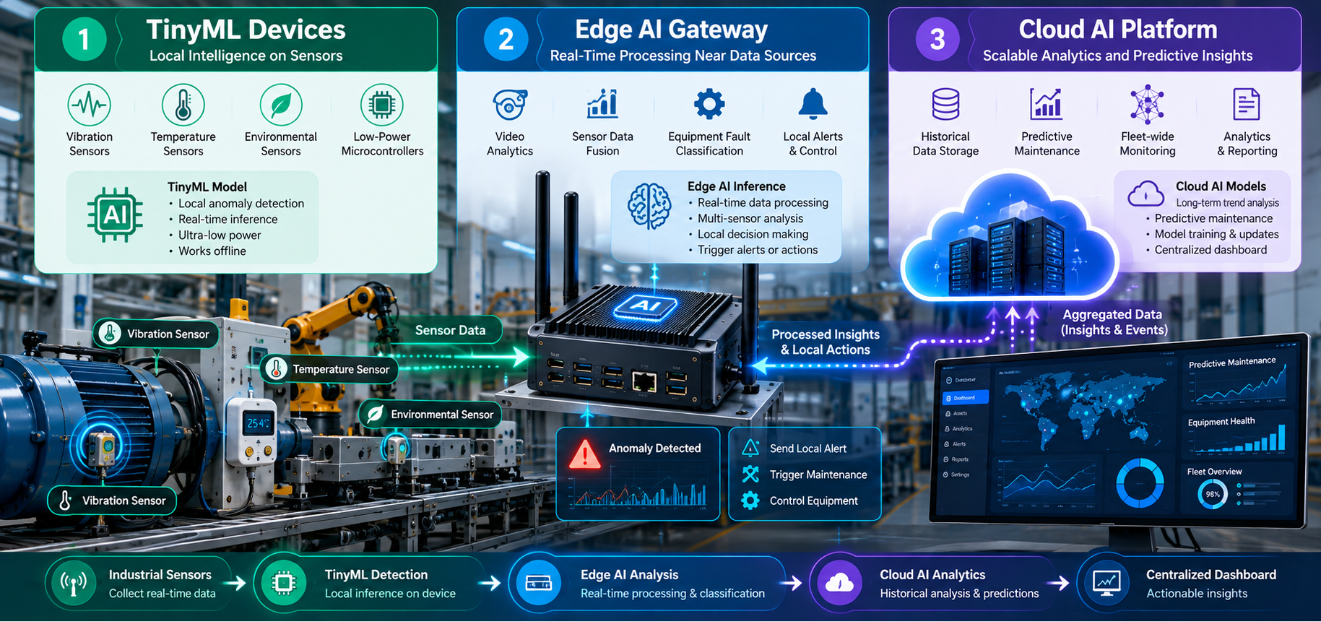
A smart sensor can detect abnormal vibrations without connecting to the internet. An industrial gateway can analyze camera feeds directly on a factory floor. A cloud platform can process information from thousands of connected devices to identify patterns that individual devices cannot detect.
All three systems use AI, but they perform inference in very different environments.
This creates an important engineering question: Where should AI inference actually run?
Understanding TinyML vs Edge AI vs Cloud AI helps organizations choose architectures that balance response time, hardware limitations, energy consumption, connectivity, privacy, and operational costs.
The right answer is not always the cloud, and it is not always the edge.
Increasingly, the most practical solution combines multiple inference environments.
What Are TinyML, Edge AI, and Cloud AI?
Before comparing these approaches, it helps to understand what AI inference means.
What Is AI Inference?
AI inference is the process of using a trained machine learning model to analyze new information and produce a prediction, classification, recommendation, or generated response.
For example, consider an industrial machine equipped with vibration sensors.
A machine learning model might analyze incoming vibration measurements and determine whether the equipment is operating normally or showing early signs of mechanical failure.
The model has already learned patterns from historical data during training.
Inference is the process of applying that trained model to new sensor readings.
The main architectural decision is where that process takes place.
What Is TinyML?
TinyML, or Tiny Machine Learning, refers to running machine learning models on highly resource-constrained devices, particularly microcontrollers.
Microcontrollers are small computing systems designed to perform specific tasks while consuming relatively little power.
They are commonly found in:
- Industrial sensors
- Wearable devices
- Smart home products
- Agricultural monitoring equipment
- Battery-powered IoT devices
- Embedded medical devices
Unlike conventional computers, many microcontrollers have limited RAM, storage, and processing capabilities.
TinyML models must therefore operate within strict hardware constraints.
Developers often use techniques such as model quantization, which reduces the numerical precision used to represent model parameters, to decrease memory requirements and computational overhead.
For example, a vibration-monitoring sensor might use TinyML to detect unusual equipment behavior locally.
Instead of transmitting every vibration measurement to a server, the device sends an alert only when the model detects an abnormal pattern.
This can reduce network traffic, improve response time, and extend battery life.
The key advantage of TinyML is the ability to perform useful AI inference on extremely constrained hardware.
However, TinyML is not suitable for every machine learning workload.
Large language models, computationally intensive computer vision systems, and complex multimodal applications generally require more capable hardware.
What Is Edge AI?
Edge AI refers to running AI inference near the location where data is generated, rather than relying entirely on centralized cloud infrastructure.
Edge AI can operate on devices such as:
- Industrial IoT gateways
- Embedded Linux computers
- Smart cameras
- Robotics controllers
- Edge servers
- Smartphones
- AI-enabled network appliances
Unlike TinyML systems, many Edge AI devices have access to more processing power, memory, and specialized AI acceleration.
For example, an industrial camera connected to an edge computing device can analyze video streams to detect missing safety equipment.
The video does not necessarily need to travel to a remote cloud server for analysis.
The edge device processes the video locally and generates an alert when a safety violation occurs.
This architecture can reduce network dependency and avoid continuously transmitting high-bandwidth video streams.
Edge AI is particularly useful when applications require rapid responses, local decision-making, or stronger control over sensitive data.
What Is Cloud AI?
Cloud AI refers to performing AI inference using computing infrastructure hosted in centralized or distributed cloud environments.
Cloud infrastructure can provide access to CPUs, GPUs, specialized AI accelerators, managed inference services, and scalable storage.
This makes cloud inference suitable for applications that require substantial computational resources or serve large numbers of users.
Common examples include:
- Generative AI applications
- Large language model inference
- Enterprise document analysis
- Advanced image processing
- Predictive analytics
- AI-powered business applications
- Large-scale IoT fleet analytics
Consider a manufacturing organization operating thousands of connected machines across multiple facilities.
Individual machines may detect local anomalies, but cloud AI can analyze aggregated data to identify recurring failure patterns across the entire fleet.
Cloud inference is particularly valuable when applications benefit from centralized processing, shared models, and elastic computing capacity.
However, it also introduces dependencies on network connectivity, data transfer, and cloud service availability.
Is TinyML a Type of Edge AI?
Yes.
TinyML is generally considered a specialized form of Edge AI.
Both approaches perform inference close to where data originates.
The primary difference is the computing environment.
TinyML focuses on highly constrained devices, especially microcontrollers.
Edge AI is a broader category that includes microcontrollers, embedded computers, gateways, smartphones, and local servers.
Cloud AI performs inference on remote computing infrastructure.
This distinction matters because an AI model that runs comfortably on an industrial gateway may be impossible to deploy on a small battery-powered sensor.
Why Does AI Inference Location Matter?
The location of AI inference directly affects how a system behaves in production.
Two applications using the same machine learning model can deliver very different results depending on where inference takes place.
Latency and Response Time
Latency is the time required for a system to respond to an input.
For AI applications, total response time may include data collection, preprocessing, network transmission, model execution, and delivery of the result.
Cloud inference introduces network communication into this process.
Edge inference can eliminate the remote network round trip for local decisions.
Consider an automated industrial inspection system.
A camera captures an image of a product moving along a conveyor belt.
The AI system must determine whether the product contains a defect before it reaches the next processing station.
If the application has a strict response-time requirement, sending every image to a distant cloud service may introduce unnecessary delays.
Local inference may provide a more predictable response.
However, Edge AI is not automatically faster.
A powerful cloud GPU may execute a large model much faster than a small edge processor.
The relevant measurement is end-to-end response time, not model execution time alone.
Connectivity and Reliability
Many IoT systems operate in environments where internet connectivity is unreliable, expensive, or unavailable.
Examples include agricultural fields, remote industrial facilities, mining sites, offshore installations, and mobile equipment.
Cloud-only inference can become unavailable when connectivity fails.
TinyML and Edge AI allow supported functions to continue operating locally.
A remote environmental monitoring device, for example, may continue detecting abnormal conditions even when its cellular connection is temporarily unavailable.
It can store measurements locally and synchronize them when connectivity returns.
Power Consumption
Power consumption is especially important for battery-powered IoT devices.
Continuously transmitting sensor data over wireless networks can consume substantial energy.
TinyML can reduce communication requirements by processing data locally.
Instead of transmitting every sensor measurement, a device might send only significant events.
However, local inference also consumes energy.
The best architecture depends on the combined energy required for sensing, computation, communication, and idle operation.
For low-power devices, this trade-off can determine whether a battery lasts weeks, months, or years.
Privacy and Data Control
Some AI applications process sensitive information, including images, audio, operational data, or personal information.
Local inference can reduce the amount of raw data transmitted outside a device or facility.
For example, a smart occupancy monitoring system may calculate the number of people in a room locally and transmit only the occupancy count.
This can reduce unnecessary exposure of raw video data.
However, Edge AI does not automatically guarantee privacy or regulatory compliance.
Devices still require secure storage, access controls, encryption, software updates, and appropriate data retention policies.
Infrastructure and Operating Costs
Cloud inference can reduce the need for dedicated local AI hardware.
However, recurring costs may include compute usage, storage, networking, managed services, and operational monitoring.
Edge AI requires investment in hardware deployment and maintenance.
TinyML may offer low per-device inference costs, but development, optimization, testing, and firmware maintenance can be significant.
The right decision depends on the complete lifecycle cost rather than the initial hardware price.
The central takeaway is that inference placement should follow application requirements, not technology preferences.
How TinyML, Edge AI, and Cloud AI Work
Although these architectures use different computing environments, they share a common machine learning workflow.
A model is trained using representative data, prepared for deployment, and then used to process new inputs.
The main difference is where inference execution occurs.
TinyML Architecture
A typical TinyML system follows this sequence:
Sensor → Microcontroller → TinyML Model → Local Decision → Optional Network Alert
Consider a battery-powered industrial vibration sensor.
The sensor collects vibration measurements from a machine.
A microcontroller processes the incoming data and extracts relevant features.
A compact machine learning model analyzes those features to identify abnormal operating conditions.
When the model detects an anomaly, the device generates an alert.
The device may transmit that alert through Bluetooth, Wi-Fi, LoRaWAN, or another communication technology.
Normal readings can remain local, depending on application requirements.
This approach reduces the need for continuous cloud communication.
The primary engineering challenges include memory management, model optimization, power consumption, and inference reliability.
Edge AI Architecture
A typical Edge AI architecture looks like this:
Sensors or Cameras → Edge Gateway → AI Inference Engine → Local Application → Cloud Synchronization
Consider a factory with multiple cameras monitoring production lines.
The cameras transmit video streams to an industrial edge computer.
The edge computer runs an object detection model to identify defects or unsafe operating conditions.
When the model detects an event, the system can trigger a local notification or send information to an industrial control application.
Selected events and operational summaries may also be uploaded to a cloud platform.
This architecture supports local decision-making while retaining centralized visibility.
Edge devices can also receive updated models and configuration changes through remote deployment mechanisms.
Cloud AI Architecture
A typical cloud inference workflow follows this sequence:
Connected Device → Internet → Cloud API → AI Model → Prediction → Application Response
Consider an AI-powered equipment maintenance platform.
Industrial devices continuously collect operational measurements.
The data is transmitted to a cloud ingestion service.
A cloud-hosted machine learning model analyzes the measurements and generates predictions.
The results appear in a web dashboard used by maintenance teams.
The platform may combine measurements from multiple facilities to identify patterns that would be difficult to detect using individual devices.
Cloud AI provides centralized model management and scalable computing resources.
However, the system must account for network availability, inference service reliability, and data transmission costs.
Hybrid Edge-Cloud AI Architecture
Many production AI systems benefit from combining local and cloud inference.
A hybrid architecture might follow this sequence:
Sensors → TinyML Detection → Edge AI Analysis → Cloud AI Analytics → Central Dashboard
Each layer performs the tasks best suited to its capabilities.
TinyML handles lightweight, immediate detection.
Edge AI performs more computationally demanding local analysis.
Cloud AI supports centralized analytics, large models, historical processing, and fleet-wide optimization.
For example, a smart manufacturing system could use TinyML to detect abnormal vibrations, Edge AI to classify the likely equipment fault, and Cloud AI to analyze failure trends across multiple factories.
Not every application requires all three layers.
The goal is to place each workload where it delivers the most value.
Planning an AI-enabled IoT product? Infolitz Software helps teams evaluate embedded hardware, edge processing, cloud infrastructure, and AI deployment architectures before committing to production. Contact our engineering team to discuss your requirements.
Tools and Technology Stack Options
Choosing the right inference environment also means selecting an appropriate software and hardware stack.
TinyML Development Tools
TinyML development typically involves compact inference runtimes, embedded development frameworks, and model optimization tools.
LiteRT for Microcontrollers
Google's LiteRT for Microcontrollers, historically associated with TensorFlow Lite Micro, is designed to execute supported machine learning models on microcontrollers and other highly constrained devices.
It provides a lightweight inference environment for embedded applications.
Developers must still account for supported operations, memory allocation, and target hardware capabilities.
Official documentation: LiteRT for Microcontrollers
Edge Impulse
Edge Impulse provides tools for collecting data, developing embedded machine learning models, optimizing inference, and deploying models to supported hardware.
It is commonly used for sensor analytics, audio classification, and embedded computer vision development.
CMSIS-NN
CMSIS-NN provides optimized neural network kernels for Arm Cortex-M processors.
These kernels can improve the performance of supported neural network operations on compatible microcontrollers.
Edge AI Development Tools
Edge AI development often involves embedded Linux, hardware acceleration, computer vision frameworks, and optimized inference runtimes.
ONNX Runtime
ONNX Runtime supports machine learning inference across multiple hardware platforms and execution providers.
It can help developers deploy supported models across different computing environments.
OpenVINO
OpenVINO provides tools for optimizing and deploying AI inference workloads on supported Intel hardware.
It is relevant for industrial computer vision, edge analytics, and other inference applications.
NVIDIA Jetson
NVIDIA Jetson is a family of embedded computing platforms designed for AI and robotics applications.
Jetson devices can support computer vision, robotics, and other accelerated inference workloads, depending on the specific hardware configuration.
Raspberry Pi
Raspberry Pi computers can support lightweight Edge AI workloads, particularly when combined with compatible acceleration hardware.
Performance depends on the model, runtime, hardware generation, and deployment configuration.
Cloud AI Development Tools
Cloud AI development typically uses managed model endpoints, GPU infrastructure, containers, and scalable inference services.
Examples include:
Amazon SageMaker AI
Amazon SageMaker AI supports machine learning development and deployment, including hosted inference workloads.
Google Vertex AI
Google Vertex AI provides managed capabilities for developing, deploying, and operating AI models.
Azure Machine Learning
Azure Machine Learning supports machine learning workflows, model management, and deployment.
vLLM
vLLM is an open-source inference and serving engine commonly used for large language models.
It can be deployed on suitable cloud infrastructure or sufficiently capable local servers.
How Should Developers Select a Stack?
The selection process should begin with workload requirements.
For microcontroller-based anomaly detection, developers should prioritize memory usage, inference time, power consumption, and compatibility with embedded hardware.
For industrial computer vision, they should evaluate model throughput, hardware acceleration, camera integration, and local reliability.
For cloud-hosted generative AI, the important considerations include model quality, GPU utilization, concurrent requests, inference costs, and data governance.
A technology stack should be selected only after defining the workload and operational constraints.
TinyML vs Edge AI vs Cloud AI: Key Differences
The three approaches differ across several important engineering dimensions.
Processing Location
TinyML typically runs directly on a microcontroller.
Edge AI runs on computing resources near the data source, including embedded devices, gateways, and local servers.
Cloud AI runs on remote computing infrastructure.
Model Complexity
TinyML is best suited to compact models that fit within limited memory and computing resources.
Edge AI can support larger models, depending on available hardware acceleration and memory.
Cloud AI can support substantially larger workloads through powerful computing infrastructure.
However, cloud deployment does not eliminate model efficiency requirements.
Large models can still create significant latency and operating costs.
Network Dependency
TinyML can perform inference without an internet connection.
Edge AI can also operate offline when its application dependencies are available locally.
Cloud AI generally requires connectivity between the application and the remote inference service.
Scalability
Cloud AI can scale inference capacity centrally by allocating additional computing resources.
Edge AI scales differently.
Increasing deployment capacity may require installing or upgrading hardware across multiple locations.
TinyML deployments can scale to large device fleets, but managing firmware, model versions, security, and hardware compatibility becomes increasingly important.
Maintenance
TinyML requires embedded software management, firmware updates, and careful validation.
Edge AI requires device monitoring, model deployment, operating system maintenance, and hardware lifecycle management.
Cloud AI centralizes many infrastructure operations but still requires monitoring, access controls, model versioning, and cost management.
Which Architecture Is Better?
There is no universally superior architecture.
TinyML is attractive when power, size, and local autonomy are primary constraints.
Edge AI is attractive when applications require local processing with more computational capability.
Cloud AI is attractive when workloads require centralized resources, large models, or elastic scaling.
Hybrid architectures are useful when applications need a combination of these capabilities.
Performance, Cost, and Security Considerations
A production AI system should be evaluated using measurable engineering criteria.
Measure End-to-End Inference Latency
Model execution time alone does not represent the full response time.
For cloud inference, total latency can include:
- Data acquisition
- Local preprocessing
- Network transmission
- Request queuing
- Model execution
- Response transmission
- Application processing
For Edge AI, network transmission may be reduced, but local processing time can increase if hardware resources are limited.
For TinyML, inference may be fast for compact models, but the processor may have strict computational limitations.
Developers should measure actual latency using representative inputs and target hardware.
For real-time systems, average latency is often insufficient.
Tail latency, such as the 95th or 99th percentile response time, can reveal occasional delays that affect reliability.
Evaluate Total Cost of Ownership
Cloud AI costs depend on factors such as compute usage, model size, request volume, storage, and data transfer.
Edge AI introduces hardware procurement, installation, power, maintenance, and replacement costs.
TinyML introduces device development, model optimization, firmware validation, and fleet management costs.
Consider an illustrative deployment with 1,000 connected sensors.
If every sensor transmits 1 KB of data once per second, the fleet generates approximately 86.4 GB of raw payload data per day, before protocol overhead and other metadata.
If each sensor instead performs local inference and transmits a 1 KB event only once per minute, the transmitted payload falls to approximately 1.44 GB per day.
That represents a reduction of about 98.3% in transmitted payload.
These figures are illustrative rather than measured results. Real savings depend on event frequency, message size, communication protocols, and system architecture.
The example demonstrates why local inference can materially affect IoT communication requirements.
However, reducing data transmission does not automatically reduce total operating costs.
The additional processing hardware, energy consumption, and maintenance requirements must also be considered.
Consider Security at Every Layer
Security responsibilities change depending on where inference runs.
TinyML security considerations include:
- Secure boot where supported
- Firmware integrity
- Protected device credentials
- Secure communication
- Signed firmware updates
- Physical device security
Edge AI security considerations include:
- Operating system hardening
- Secure model deployment
- Device identity management
- Network segmentation
- Access controls
- Encrypted storage
- Remote patch management
Cloud AI security considerations include:
- Identity and access management
- API authentication
- Data encryption
- Network security
- Model endpoint protection
- Logging and monitoring
- Data retention policies
Hybrid systems must protect communication and trust boundaries between all layers.
Protect Model Integrity
AI models are valuable software assets.
Attackers may attempt to modify model files, manipulate input data, or exploit weaknesses in the deployment environment.
Production systems should validate model artifacts before deployment and restrict unauthorized changes.
For connected IoT products, secure over-the-air updates are especially important.
An OTA update mechanism allows devices to receive new firmware or model versions remotely.
A robust deployment process should include version compatibility checks, integrity verification, staged rollout, and recovery mechanisms.
Plan for Model Drift
Model drift occurs when changes in real-world data reduce the effectiveness of a deployed machine learning model.
An industrial anomaly detection model trained on one operating environment may perform differently when machine conditions, sensor characteristics, or production processes change.
Monitoring should therefore include more than device uptime.
Teams should track prediction quality, data quality, model versions, and relevant operational outcomes.
Need to decide whether inference belongs on a device, gateway, or cloud platform? Infolitz Software supports AI architecture evaluation, embedded development, cloud integration, and production deployment. Contact us to review your application requirements.
Real-World Use Cases for TinyML, Edge AI, and Cloud AI
Different industries benefit from different inference architectures.
Use Case 1: Predictive Maintenance in Manufacturing
Industrial equipment generates operational data such as vibration, temperature, current, and pressure measurements.
Machine learning models can analyze these signals to identify unusual operating conditions.
TinyML approach
A microcontroller connected to a vibration sensor performs lightweight anomaly detection.
When it detects an unusual pattern, it sends an alert to a gateway.
Edge AI approach
An industrial gateway receives information from multiple machines and performs more detailed fault classification.
It may combine vibration, temperature, and electrical measurements to improve diagnostic accuracy.
Cloud AI approach
A cloud platform analyzes historical data across machines and facilities.
It identifies recurring failure patterns and supports maintenance planning.
A hybrid system can combine immediate local detection with centralized long-term analysis.
Use Case 2: Smart Environmental Monitoring
Environmental monitoring systems measure conditions such as particulate matter, temperature, humidity, carbon dioxide, and volatile organic compounds.
TinyML approach
A low-power sensor device identifies unusual environmental patterns and reduces unnecessary transmissions.
Edge AI approach
A local gateway combines measurements from multiple sensors and detects abnormal conditions within a building or facility.
Cloud AI approach
A centralized platform analyzes environmental trends across multiple sites and supports reporting, visualization, and historical analysis.
For applications involving exposure assessment, the architecture may also incorporate occupancy and duration information.
This enables analysis that considers both environmental conditions and the time people spend in monitored spaces.
Use Case 3: Industrial Computer Vision
Manufacturing facilities increasingly use AI-powered cameras for visual inspection and safety monitoring.
A typical system may detect:
- Product defects
- Missing components
- Incorrect assembly
- Equipment abnormalities
- Unsafe operating conditions
TinyML may be appropriate for simple visual classification on highly constrained hardware.
Edge AI is often more suitable for continuous video processing and object detection.
Cloud AI may support centralized model training, historical analysis, and quality reporting.
The optimal architecture depends on image resolution, frame rate, model complexity, and response-time requirements.
Use Case 4: Smart Agriculture
Agricultural IoT systems often operate in remote environments with limited connectivity.
TinyML can support local sensor-based decisions using battery-powered devices.
Edge AI gateways can combine information from multiple sensors, cameras, and agricultural equipment.
Cloud AI can analyze historical conditions, weather information, and farm-level operational data.
For example, a local device might detect an abnormal irrigation condition while a cloud platform evaluates seasonal water usage patterns.
This separation reduces dependence on continuous connectivity for immediate decisions.
Use Case 5: Generative AI Applications
Generative AI introduces additional considerations because model size, memory requirements, and computational demand can be substantial.
Small language models can run on capable edge devices.
However, larger models may require GPUs, substantial memory, or cloud-hosted inference services.
A hybrid generative AI application might use a compact local model for basic classification or routing and send complex requests to a cloud-hosted model.
For example, an industrial maintenance assistant could use local AI to identify the equipment associated with a technician's request.
More complex questions involving extensive technical documentation could be processed using a larger cloud-hosted model.
This approach can reduce unnecessary cloud requests while preserving access to more capable models.
The design must also account for network availability, data sensitivity, and the possibility that cloud services may be unavailable.
How to Choose Where AI Inference Should Run
The most reliable way to select an inference architecture is to evaluate the workload systematically.
Step 1: Define the AI Task
Start by identifying what the model must accomplish.
Examples include anomaly detection, image classification, object detection, forecasting, speech recognition, or text generation.
Different workloads have very different computing requirements.
A compact sensor classification model may run comfortably on a microcontroller.
A complex multimodal generative AI model may require substantially more powerful hardware.
Step 2: Establish Response-Time Requirements
Determine how quickly the system must produce a result.
Some applications can tolerate several seconds of processing.
Others require decisions within milliseconds.
Measure the complete application workflow, including communication and processing delays.
For safety-related applications, AI inference should not replace independently validated safety controls without appropriate engineering and certification.
Step 3: Evaluate Hardware Constraints
Identify available processor capabilities, RAM, storage, acceleration hardware, and power budgets.
For battery-powered devices, estimate the energy required for both computation and communication.
For industrial gateways, evaluate thermal constraints, operating conditions, and hardware availability.
Step 4: Assess Connectivity
Determine whether the application can depend on continuous network access.
If connectivity is unreliable, identify which functions must remain available locally.
Some applications may operate normally without the cloud but synchronize historical information later.
Others may require remote services for essential functions.
Step 5: Evaluate Privacy and Security Requirements
Identify what data the application processes and where that data may be stored or transmitted.
Sensitive information may require local processing, encryption, restricted access, or specific data residency arrangements.
Security requirements should be considered before selecting the deployment architecture.
Step 6: Estimate Lifecycle Costs
Compare hardware, infrastructure, communication, maintenance, development, and model update costs.
A cloud solution may be economical for low-volume workloads but expensive when inference requests increase substantially.
An edge solution may reduce recurring cloud costs but introduce distributed hardware maintenance.
The comparison should reflect expected production volumes.
Step 7: Build a Representative Prototype
Test the selected model using real or representative input data.
Measure:
- Inference latency
- Memory consumption
- CPU or accelerator utilization
- Energy consumption
- Prediction accuracy
- Network usage
- Failure recovery behavior
Avoid selecting hardware based only on published benchmark numbers.
Performance can vary significantly depending on model architecture, input size, optimization, and runtime configuration.
Step 8: Design for Production Operations
A successful prototype is not automatically production-ready.
Plan for model updates, device monitoring, logging, security patches, deployment rollback, and long-term maintenance.
For large IoT fleets, remote management capabilities are especially important.
The architecture should support the complete operational lifecycle of the AI system.
Best Practices and Common Pitfalls
AI inference placement decisions often fail when teams optimize one technical metric while ignoring the wider system.
Best Practice: Start With the Workload
Select hardware and infrastructure after understanding model requirements.
A common mistake is choosing a powerful edge device before confirming whether a simpler microcontroller can perform the required task.
The opposite mistake is attempting to force a complex model onto hardware that cannot support it reliably.
Best Practice: Optimize Data Movement
Moving data between devices and cloud services can introduce latency, communication costs, and security considerations.
Where practical, process high-volume data close to its source.
Transmit only the information needed by downstream applications.
For example, a camera-based monitoring system may transmit detected events rather than continuous video.
However, some applications require raw data retention for investigation, retraining, or regulatory reasons.
Data reduction strategies must reflect these requirements.
Best Practice: Separate Training From Inference
Model training and model inference have different computational requirements.
Many TinyML and Edge AI applications train models using more powerful development or cloud infrastructure.
The resulting optimized model is then deployed to the target device.
This separation allows constrained devices to perform inference without carrying the computational burden of training.
Best Practice: Design for Updates
AI models may require periodic updates as operating conditions change.
For embedded devices, updates should account for limited storage, interrupted connectivity, and compatibility with existing firmware.
For edge gateways, model deployment should include version management and rollback procedures.
For cloud AI, teams should manage model endpoints, traffic routing, and deployment monitoring.
Common Pitfall: Assuming Local AI Is Always Cheaper
Local inference can reduce cloud requests and data transmission.
However, dedicated hardware, maintenance, energy consumption, and deployment complexity may offset those savings.
Cost comparisons should use realistic production workloads.
Common Pitfall: Ignoring Model Accuracy
A heavily optimized model may consume less memory and execute faster.
However, optimization can sometimes reduce prediction quality.
Developers should evaluate model accuracy after quantization, pruning, or other optimization techniques.
Common Pitfall: Treating Edge AI as Automatically Secure
Local processing can reduce data exposure, but distributed devices create additional security responsibilities.
An unmanaged edge device can become a vulnerable entry point into an industrial network.
Secure provisioning, monitoring, updates, and access controls remain essential.
TinyML vs Edge AI vs Cloud AI: Which Should You Choose?
The decision becomes clearer when viewed through common application requirements.
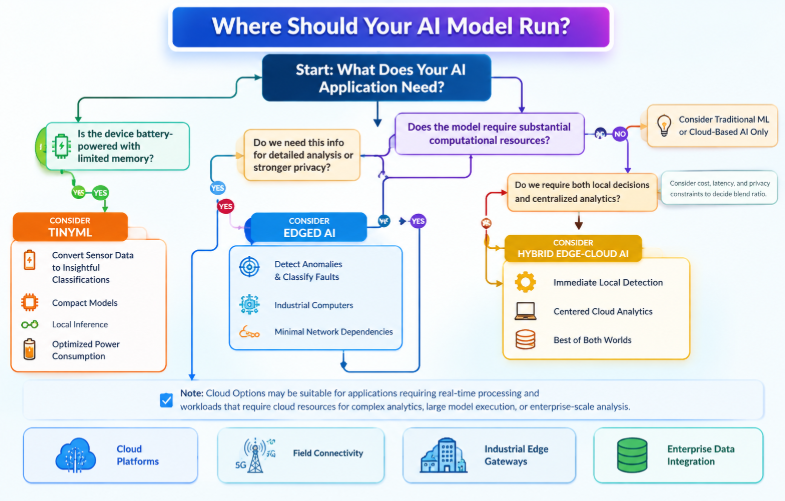
Choose TinyML When:
- The device has limited RAM and processing power.
- Battery life is a major concern.
- The AI model is compact.
- Local inference must operate without connectivity.
- The application performs lightweight classification or anomaly detection.
- Reducing wireless communication is important.
Typical applications include wearable sensors, industrial monitoring nodes, and low-power smart devices.
Choose Edge AI When:
- The application requires local processing.
- Data volumes are too large for continuous cloud transmission.
- The model requires more computing resources than a microcontroller can provide.
- Real-time response is important.
- Connectivity may be intermittent.
- Local data processing is preferred for operational or privacy reasons.
Typical applications include industrial computer vision, robotics, smart cameras, and IoT gateways.
Choose Cloud AI When:
- The workload requires substantial computational resources.
- Large language models or complex AI models are involved.
- Centralized processing is desirable.
- Demand varies significantly over time.
- Data from multiple locations must be analyzed together.
- Network connectivity is sufficiently reliable for the application.
Typical applications include enterprise generative AI, centralized analytics, and large-scale model serving.
Choose Hybrid AI When:
- Some decisions must happen locally.
- Other workloads require centralized processing.
- Devices operate with intermittent connectivity.
- Data transmission must be controlled.
- Multiple levels of AI analysis provide operational value.
Hybrid architectures are particularly relevant for industrial IoT platforms, connected products, smart infrastructure, and distributed monitoring systems.
The best architecture is the one that meets the application's measurable requirements with acceptable cost, risk, and operational complexity.
Frequently Asked Questions
What is the main difference between TinyML, Edge AI, and Cloud AI?
The main difference is where AI inference runs and the computing resources available.
TinyML typically runs compact machine learning models on microcontrollers.
Edge AI runs models on devices or computing infrastructure close to the data source.
Cloud AI performs inference using remote computing infrastructure.
Is TinyML better than Edge AI?
TinyML is not inherently better than Edge AI.
TinyML is a specialized form of Edge AI designed for highly constrained hardware.
It is suitable for compact models and low-power applications.
More capable edge computers are generally better suited to computationally demanding workloads.
Can TinyML work without the internet?
Yes.
TinyML models can perform inference entirely on a microcontroller without an internet connection.
However, applications may still require connectivity for monitoring, synchronization, configuration, or software updates.
Is Edge AI faster than Cloud AI?
Edge AI can provide lower end-to-end latency by eliminating remote network communication.
However, cloud infrastructure may execute computationally demanding models faster because it can provide more powerful processors and accelerators.
Actual performance depends on the workload, hardware, network conditions, and application architecture.
What hardware is needed for TinyML?
TinyML commonly runs on microcontrollers such as Arm Cortex-M-based devices and other supported embedded processors.
Hardware requirements depend on model size, memory consumption, processing needs, and energy constraints.
Can generative AI run on edge devices?
Yes.
Compact generative AI models can run on sufficiently capable edge hardware.
However, memory requirements, computational demand, model quality, and response speed must be evaluated.
Larger generative models may still benefit from cloud GPUs or dedicated local servers.
Which approach is best for industrial IoT?
Industrial IoT applications often benefit from hybrid architectures.
TinyML can support local sensor intelligence.
Edge AI can provide real-time equipment monitoring and local analytics.
Cloud AI can support fleet-wide analysis, centralized reporting, and advanced predictive models.
The right combination depends on operational requirements.
Does Edge AI eliminate cloud costs?
No.
Edge AI can reduce cloud inference and data transmission requirements, but it introduces hardware and maintenance costs.
Many edge systems also continue using cloud services for device management, model updates, historical storage, and centralized analytics.
What is hybrid edge-cloud AI?
Hybrid edge-cloud AI combines local inference with cloud-based processing.
Time-sensitive or privacy-sensitive workloads can run locally, while computationally intensive or centralized tasks run in the cloud.
The architecture allows different workloads to use the computing environment best suited to their requirements.
How do I decide where AI inference should run?
Start by evaluating model complexity, latency requirements, hardware resources, power consumption, connectivity, privacy, and lifecycle costs.
Then test the model using representative workloads on the intended hardware.
The final decision should be based on measured performance and operational requirements rather than assumptions.
The future of AI is not about running every model in the cloud or pushing everything to the edge. It is about placing intelligence where it delivers the right balance of speed, efficiency, reliability, and cost.

Conclusion
Choosing between TinyML vs Edge AI vs Cloud AI requires more than comparing processing power. The right architecture must balance latency, connectivity, model complexity, energy consumption, security, and long-term costs.
For organizations developing AI-enabled IoT products, industrial monitoring platforms, or connected applications, Infolitz Software Pvt. Ltd. provides engineering support across embedded systems, Edge AI, cloud infrastructure, and AI integration.
Contact Infolitz Software to discuss the right AI inference architecture for your application.


